Category: Personal Growth

  • How to Start a Blog From Scratch: An Honest Beginner’s Guide

    How to Start a Blog From Scratch: An Honest Beginner’s Guide


    The Honest Version Nobody Posts on Pinterest

    If you’ve spent more than ten minutes Googling how to start a blog from scratch, you’ve probably noticed that every article reads like a checklist written by someone who is not, in fact, blogging. Pick a niche. Buy a domain. Install a theme. Publish. Make six figures by Tuesday.

    I’m writing this from the other side of those tutorials — the side where you actually do the thing, get stuck on something nobody warned you about, and quietly close your laptop at 1 a.m. wondering if everyone else found this easier than you did.

    This is the post I wish someone had written before I started By Sofi Maruri. No affiliate-stuffed listicle, no fake “I made $10K my first month” screenshots. Just the real timeline of building a blog from zero, in your late twenties, with a full life happening around it.

    I didn’t have a mentor, a course, or a friend who’d done this before me. I had open browser tabs, contradictory advice, and a lot of wasted weekends. That detail matters for the rest of this post, so hold onto it.

    Why I started a blog before 30

    I didn’t start blogging because I had a content strategy. I started because I needed somewhere to put the version of myself that didn’t fit anywhere else.

    I’d left a corporate path that looked good on paper, started building a slower, more intentional life in Chile, and realized I had a lot of things to say about travel, food, personal growth, and the strange in-between of figuring out adulthood without a manual. The blog became the container for all of it.

    If you’re considering starting a blog from scratch, the first honest thing I can tell you is this: a niche you can sustain matters more than a niche that ranks. If you don’t actually want to write about it on a Tuesday night when nobody is reading, no SEO strategy will save you.

    The expectations vs. the reality

    Here’s what I thought starting a blog would look like:

    1. Buy a domain (cute).
    2. Pick a beautiful theme (fun).
    3. Write posts (I love writing).
    4. Watch traffic come in (sure, why not).

    Here’s what it actually looked like:

    1. Spend a week comparing hosting plans, second-guessing every choice.
    2. Buy the domain. Feel briefly powerful.
    3. Open WordPress for the first time and immediately want to close it.
    4. Try to make a homepage. Fail. Try a different theme. Fail differently.
    5. Reset everything. Start over.
    6. Realize “writing posts” is maybe 20% of having a blog.
    7. Cry a little. Keep going anyway.

    If your version of starting a blog from scratch involves a meltdown around step four — congratulations, you’re doing it normally.

    The disaster that actually taught me something

    A few weeks in, I made the classic beginner mistake: I tried to make my blog look exactly like a Pinterest screenshot. I downloaded a complicated theme, installed plugins I didn’t understand, and built a homepage that looked beautiful for about six hours before something broke and I couldn’t undo it.

    I had to do a full reset. Theme gone. Layout gone. The fake productivity of “look how much I’ve built” — gone.

    That reset is the most useful thing that’s happened to my blog so far, and here’s why: it forced me to start with the boring stuff first. Permalinks. Category slugs. A clean static homepage. A theme (I switched to Kadence — Astra is also great) that didn’t require a paid version to look like a real website. An About page written like a human wrote it.

    The lesson: when you start a blog, build the skeleton before the skin. Everything cute you want to do later — sticky menus, fancy fonts, animated buttons — will be easier on top of a clean structure than retrofitted onto a mess.

    What I’d do differently to start a blog from scratch

    If you’re at the very beginning and want to start a blog from scratch, here’s the order I’d actually recommend, based on what saved me time vs. what I had to redo:

    1. Pick a long-game domain, not a clever one. Your name, or a phrase that isn’t tied to your current life stage. I love that mine includes my name — it grows with me.

    2. Choose hosting based on price and ease, not on the affiliate review with the most stars. I use Hostinger Premium (around USD 5/month) and it’s been more than enough to start. You don’t need enterprise hosting in month one.

    3. Use a free, lightweight theme from day one. Kadence and Astra are both excellent. Don’t pay for a theme until you know exactly what features you need. You probably won’t need them.

    4. Set up your structure before you write anything. Permalinks, categories, tags, your main pages (Home, About, Contact, a basic Newsletter page). This takes one focused afternoon and saves you weeks of cleanup later.

    5. Write the About page like you’re talking to one person. Not “Welcome to my blog, a space where I share…”. Write it like you’re explaining yourself to someone you actually like.

    6. Install only the plugins you need. For most beginners that’s: an SEO plugin (Yoast or RankMath), a caching plugin, and a backup plugin. That’s it. The plugin rabbit hole is real.

    7. Publish before it’s perfect. Your first post will be cringe in six months. So will mine. That’s how you know you’re growing.

    The tools that actually earned their place

    After months of trial, error, and reset buttons, this is the short list of what I actually use and recommend if you’re starting a blog from scratch:

    • WordPress.org as the platform (not .com — this matters)
    • Hostinger for hosting
    • Kadence as the theme
    • Gutenberg as the editor (no Elementor — the free version locks too much behind Pro)
    • Yoast for SEO
    • MailerLite for email — generous free plan, not ugly, not overwhelming
    • Pinterest for traffic — especially if you write in two languages like I do
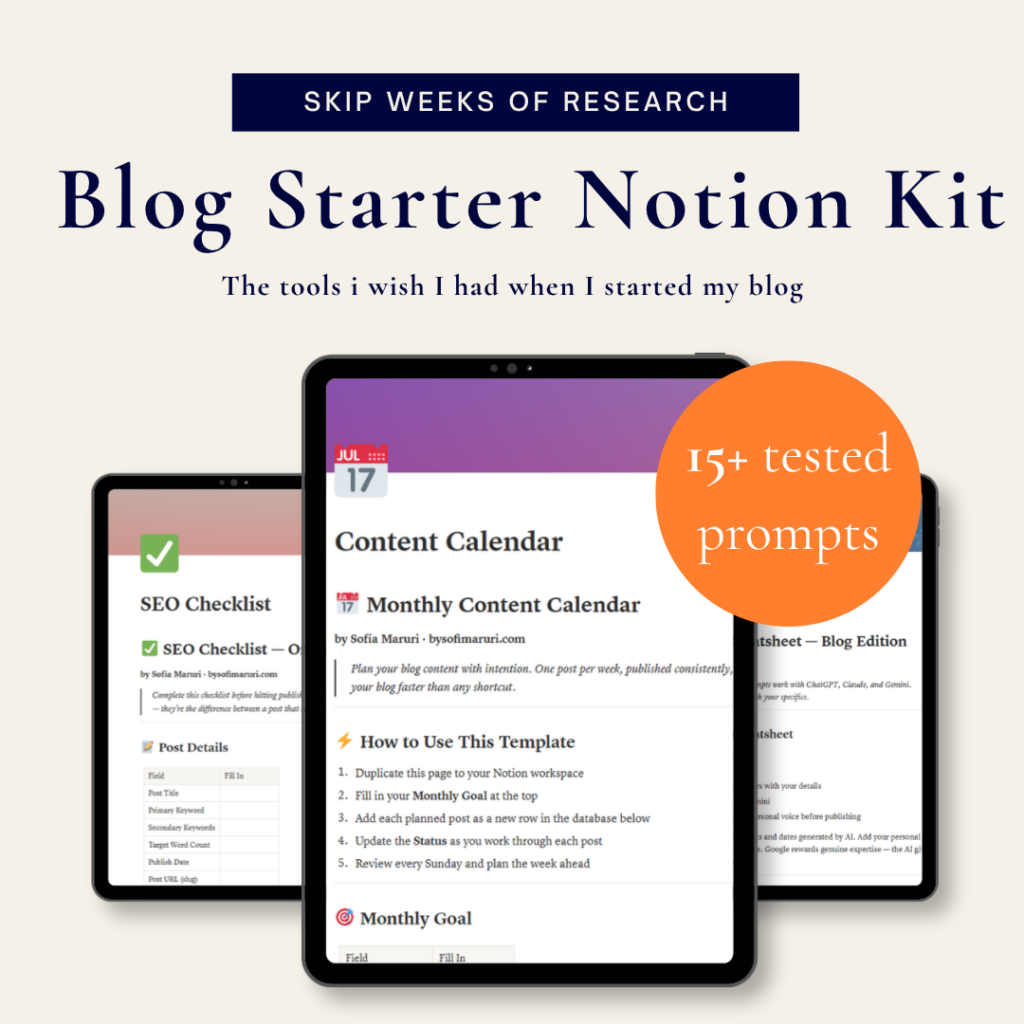
    • Notion for everything behind the scenes: editorial calendar, post drafts, SEO tracking, ideas

    The Notion piece is the one nobody talks about enough. You will drown in ideas, drafts, half-finished outlines, and SEO research within your first month. Having a system for that isn’t optional — it’s the difference between blogging consistently and ghosting your own blog for six weeks.

    My first month, in real numbers

    Since I’m committed to honesty in this post, here’s exactly what one month of blogging looked like for me:

    • Total Amazon affiliate commissions: $0.37
    • Total clicks: 48
    • Total reward earnings: $0.00

    Yes, thirty-seven cents. I am not joking, and I am not embarrassed.
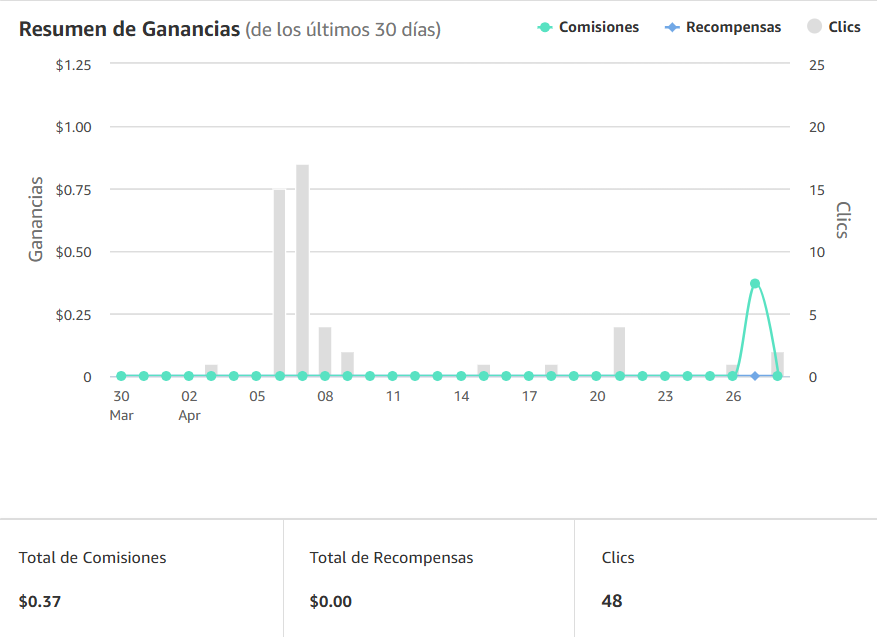
    Amazon affiliate dashboard showing first month earnings of $0.37 from 48 clicks

    I’m sharing the actual screenshot because the internet is full of “I made $5,000 my first month blogging” stories, and they’re either lying or selling you a course where the only person making $5,000 is them. The real first month of a blog, for almost everyone, looks like single-digit dollars and a lot of refreshing.

    Here’s why I’m proud of $0.37 anyway:

    • It’s $0.37 I didn’t have last month
    • Those 48 clicks are 48 real human beings who landed on my blog and trusted me enough to click through
    • Every single one of those clicks came from Pinterest, not Google — which means SEO traffic is still entirely ahead of me
    • It’s proof of concept that the system works, just at a tiny scale

    If you’re starting a blog and your first month earns you a coffee, you didn’t fail. You did the thing. The numbers compound — but only if you keep showing up.

    The lesson I’d pass on: Pinterest is the fastest traffic channel for a brand-new blog. Google takes months to trust you. Pinterest will start sending you visitors in week one if you pin consistently. If you only have time for one off-blog channel in your first 90 days, make it Pinterest.

    The shortcut to start a blog from scratch

    Most of what I just shared took me months to figure out — partly because every tutorial assumes you already know what a permalink is, and partly because there’s no map for the in-between of “I want a blog” and “I have a blog that actually works.”

    I didn’t have any of this when I started… so I built the resources I wish someone had handed me — and the only honest reason they exist is to save you the weeks I lost.

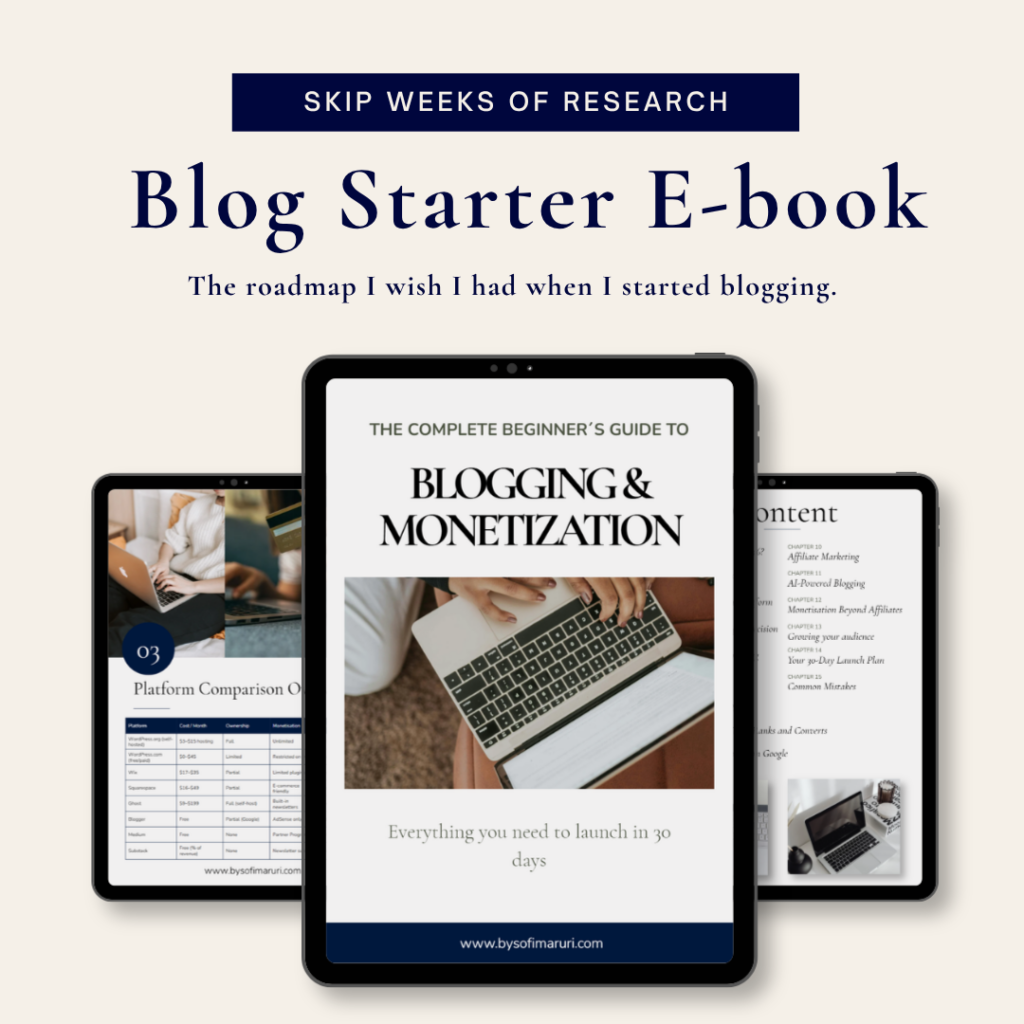
    [The Beginner Blog Ebook] — the full step-by-step of starting a blog from scratch, written the way I’d explain it to a friend who asked me over coffee. Hosting, domain, theme, structure, first posts, common mistakes, and the unsexy technical stuff in plain language.

    [The Notion Templates for Bloggers] — the actual system I use to plan posts, track SEO keyphrases, manage my editorial calendar, and keep ideas from disappearing into my Notes app.

    If you’d rather DIY it from blog posts and YouTube tutorials, I respect that — that’s how I started too. But if you’re trying to start a blog from scratch without losing weeks to mistakes I already made, those are the shortcuts I genuinely wish someone had handed me.
    The thing nobody tells you about how to start a blog from scratch

    Starting a blog from scratch is less about technical skill and more about emotional stamina. The tutorials make it look like a weekend project. It’s not. It’s a slow build of small decisions, broken layouts, deleted drafts, and the quiet practice of showing up to a thing nobody is watching yet.

    But there’s something real on the other side of that. A piece of the internet that’s actually yours. A place to put what you think. A small business that grows on your own time, in your own voice, on your own domain.

    If you’re standing at the beginning of that, scrolling through tutorials and wondering if you can really do it: you can. You’ll mess up the way I messed up. You’ll reset something at some point. You’ll publish posts that feel embarrassing in retrospect.

    The trade is your time… Either way, you’ll end up with a blog. The only question is how many late nights you want to lose on the way there.

    You’ll also, eventually, be the person writing the honest version for someone else.


    Did this help? The full beginner ebook and the Notion templates I use are linked above — and if you want the next post (probably “10 free WordPress plugins I actually use”), the easiest way to not miss it is to join the email list at the bottom of this page.

  • My corporate burnout recovery journey

    My corporate burnout recovery journey

    Personal growth · Self-improvement · Burnout recovery


    I spent four years in corporate life convincing myself that the anxiety I felt every Sunday night was normal. That the dread of walking into an office was just part of being an adult. That everyone felt this way — and that burnout recovery and personal growth were things other people needed, not me. I was wrong. And it took losing my grandmother, and watching my boss not even ask how I was doing, to finally see it clearly.


    Three Jobs, One Burnout Pattern

    My corporate life wasn’t a straight line. I worked as an office manager at a law firm, then as an alumni relations coordinator at a university, and eventually landed what looked like my “big break” — brand manager and head of marketing at a fintech startup.

    Different industries. Different teams. Different cities, almost. But the same suffocating routine: wake up, commute, perform, repeat. A 9-to-6 that slowly started feeling like a 9-to-never.

    What bothered me most wasn’t the work itself — I’m someone who genuinely cares about what I do. It was the meaninglessness of the rhythm. The meetings that could’ve been emails. The performance reviews that measured everything except whether you actually felt like a human being. The slow erosion of asking why am I doing this? and hearing only silence back.

    I later started reading Bullshit Jobs by David Graeber and felt seen on every single page. If you’ve ever sat at your desk wondering whether your job would matter if it disappeared tomorrow — read it. It will either terrify you or set you free. For me, it was both.


    The Moment My Corporate Life Broke Me

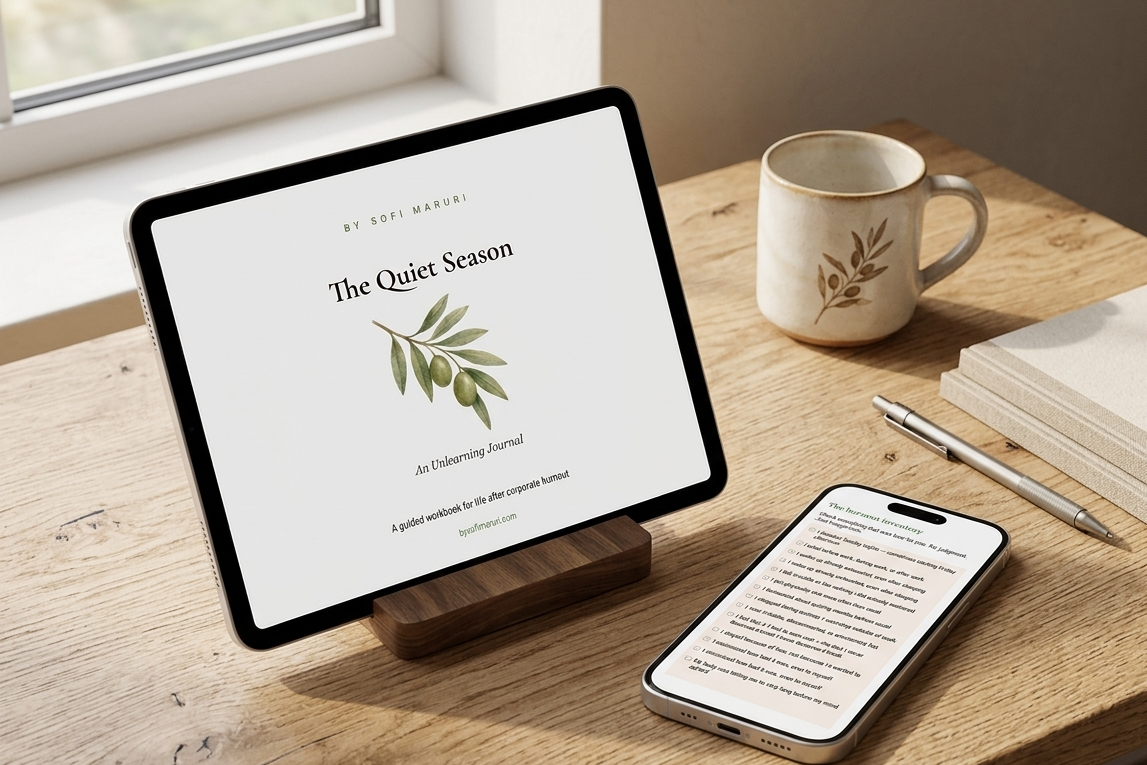
    If you’re reading this and realizing that, like me, you’ve been minimizing your own pain to stay functional, I want to share something with you. I created a guided workbook called The Quiet Season to help process exactly these moments. It’s not a productivity tool; it’s a safe space to name what happened and start unlearning the beliefs that led to the burnout.

    There is a specific memory I return to when I question my decision to leave.

    My grandmother was sick. Then she was gone. And in the middle of that grief — raw, disorienting, the kind that changes how you see everything — not one person at work asked how I was doing. Not a message. Not a glance. Just: when are you back? we need the report.

    My psychiatrist had been gently suggesting a mental health leave for a while. I kept saying no. I was terrified of what people would think. That they’d see me as weak, unstable, not cut out for it. That taking a leave for burnout was somehow more shameful than quietly falling apart in a bathroom stall between meetings.

    That fear, I’ve since learned, is not a personal flaw. It’s a cultural one. We’ve been conditioned to treat mental health as a productivity problem — something to manage so you can get back to performing. Not something worth stopping for.

    I didn’t take the leave. Instead, I spent six months mentally rehearsing my resignation before I actually did it.


    Quitting Without a Plan B

    I resigned without another job lined up. No soft landing, no backup offer, no savings runway carefully calculated in a spreadsheet.

    Some people called it brave. Others probably thought I was being reckless — and honestly, they’re not entirely wrong. The financial security of a monthly salary is real, and losing it is genuinely scary. I won’t romanticize that part.

    But I also knew that if I stayed one more year waiting for the “right moment,” there would always be another reason to wait.

    So I left.


    What Nobody Tells You About Life After Burnout

    The first thing I did after leaving corporate life was question everything.

    I thought I’d feel relief. And I did — briefly — before the fear moved in and made itself at home. What if I can’t do this? What if the blog never grows? What if I run out of money and have to go back? The silence that used to feel suffocating in the office now felt like a different kind of pressure: the pressure of total freedom with no structure to hide behind.

    I’m still in that uncertainty. I want to be honest about that, because most “I quit my job” posts skip this part. The truth is I don’t know yet where this goes. I don’t know how long this season will last. I just know that the version of me who was crying in office bathrooms was not the version I want to become.

    What I do know is that some things have genuinely helped.


    What’s Actually Helped Me (Honest List, No Filters)

    1. EMDR Therapy

    This has been the most significant thing I’ve done for myself, full stop.

    EMDR (Eye Movement Desensitization and Reprocessing) is a therapeutic approach originally developed for trauma, but it works on the deeper stuff too — the irrational beliefs and nervous system patterns you’ve been carrying for years without realizing. Things like I have to earn rest, or if I’m not productive I have no value, or asking for help means I’m weak.

    I didn’t understand how much of my burnout was rooted in beliefs I’d internalized long before any of my jobs. EMDR helped me start untangling that. If you’re in a place where regular talk therapy feels like it’s not reaching the root — ask about EMDR.

    2. Journaling (The Non-Aesthetic Kind)

    I don’t journal to have a beautiful spread. I journal to get the noise out of my head and onto paper before it convinces me of something that isn’t true.

    No rules, no format. Just honest writing, especially on the hard days.

    While I believe in ‘non-aesthetic’ journaling, I know that staring at a blank page can be overwhelming when you’re exhausted. That’s why I turned my own unlearning process into The Quiet Season Journal. It includes the specific prompts and recognition checklists that helped me find clarity when my brain felt like static. You can download it for free if you need a place to start.

    3. Drawing as a Self-Improvement Tool

    corporate burnout recovery personal growth

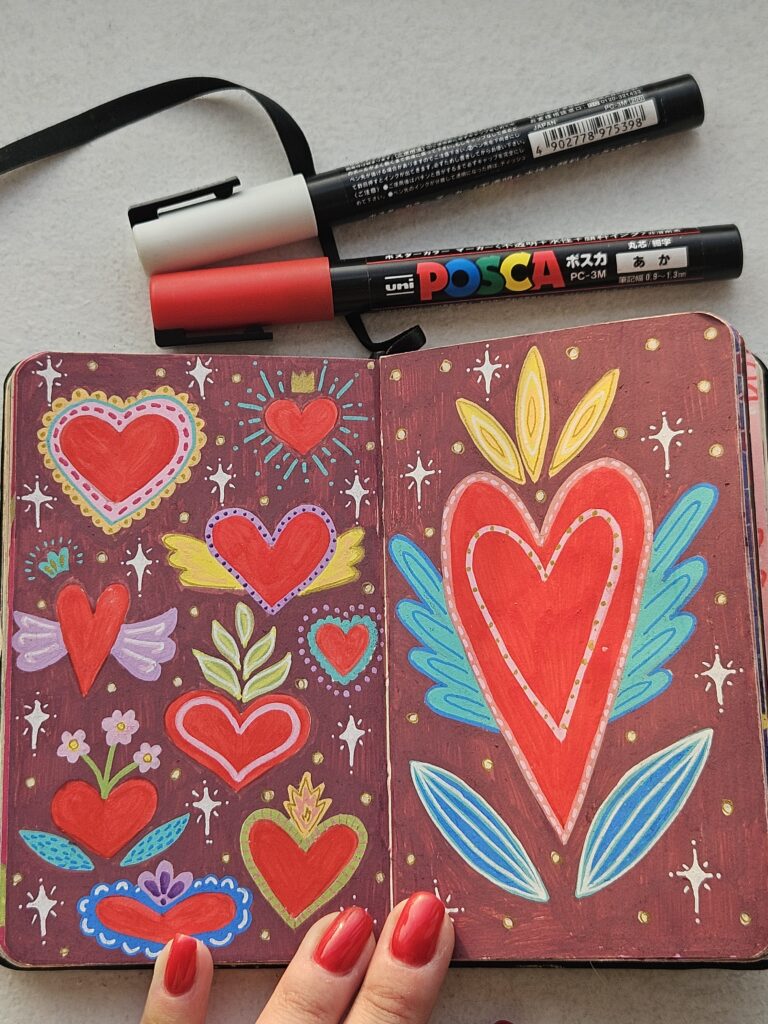
    I draw with Ohuhu markers and Posca paint pens — not because I’m an artist, but because it’s one of the only activities that fully shuts my brain off. There’s something about choosing colors and filling in a shape that short-circuits the spiral of anxious thoughts. It’s meditative in a way I didn’t expect.

    If you’ve been meaning to try an analog creative outlet, I genuinely recommend starting with Posca pens — they work on almost any surface and require zero prior experience.

    4. A Physical Planner

    I tried going fully digital. It didn’t work for me. Something about writing things down by hand creates a different kind of commitment and clarity. My weekly planner is one of the first things I reach for in the morning — not my phone.

    For anyone in a period of transition, having even a loose structure on paper can be grounding when everything else feels uncertain.

    5. My Bicycle

    This one doesn’t have an affiliate link. It’s just my bike, and I love it.

    One of the small, specific freedoms I dreamed about when I was still in the office: riding my bicycle at 11am on a Tuesday, just because I can. I do that now. It sounds trivial, but it represents something bigger — the ability to be present in my own life, at my own pace.


    Where I Am Now: My Personal Growth Journey

    I’m building this blog. I’m on Pinterest. I’m writing in both Spanish and English for the first time, which feels surprisingly like coming home to myself.

    I don’t have a success story to wrap this up with. I’m in the middle of the story — somewhere between “I left” and “I figured it out.” And I’ve decided that’s okay. That the middle is allowed to be uncertain and uncomfortable and still worth being in.

    If you’re reading this and you’re in your own version of Sunday night dread, I’m not going to tell you to quit your job. That’s a decision with real consequences that only you can weigh.

    But I will tell you this: the anxiety you feel is information. The fact that your body is protesting every morning is not weakness — it’s your nervous system telling you something doesn’t fit. You’re allowed to listen to it.

    And if helping just one person feel less alone in this makes the whole thing worthwhile — then I’m already exactly where I need to be.


    If this resonated with you, save it for later or share it with someone who needs it. And if you’re somewhere in your own transition — I’d really love to hear about it in the comments.

    I don’t have all the answers yet, but I do have a map of the territory I’ve covered so far. If you are in the middle of your own transition and need a quiet way to navigate the uncertainty, you are welcome to use The Quiet Season. It’s 35 pages of honest prompts designed for life after the corporate world—no performance required.

  • From the Office to Chaos: How I Organized My Scattered Mind (and My Days) When I Lost My Routine

    From the Office to Chaos: How I Organized My Scattered Mind (and My Days) When I Lost My Routine


    This post may contain affiliate links, which means I may earn a small commission if you choose to purchase through them — at no extra cost to you. I only share things I genuinely love or would use myself.


    Going from a strict 9-to-5 corporate schedule to having all the time in the world in front of you sounds like a dream come true. At least, that’s what I thought. But when I found myself in my first month of unemployment, reality hit me hard: I felt completely lost.

    For years, my life was dictated by alarms, calendar meetings, urgent deadlines, and bosses. Suddenly, all that structure vanished. I had an endless list of things I wanted to do and many others I needed to do, but my brain simply didn’t know where to start. If you’re also wondering how to organize your week without a routine, you’re not alone — and there is a way out.

    Today, I want to tell you how I got out of that loop, how to organize your week without a routine when you’ve lost the structure of corporate life, and the tools that saved my mental health.

    Working in Alumni Relations 2023
    3rd job! Alumni Relations 2023
    Becoming a manager in 2023 with a strict routine
    4th Job! Brand Manager 2024

    The Culture Shock of Losing the Corporate Routine

    The first mistake I made when I became unemployed was trying to replicate the exact rigidity of the office at home. I would set strict alarms and fill a piece of paper with twenty giant tasks. Spoiler alert: it didn’t work.

    Scattered minds do not function well under self-imposed, monotonous pressure. When you are in an office, the environment forces you to focus (or at least pretend to). But when you are alone at home, freedom can become your worst enemy if you don’t have an anchor system. Start with something small and grounding, like making yourself a real breakfast — these 10-minute oat banana pancakes are my go-to.

    I realized I didn’t need “military discipline”; what I needed was a daily and weekly reset. A visual space to braindump everything so my mind could stop spinning.

    The 3-Step Method to Organize Your Week Without a Routine

    After a lot of trial, error, and abandoned notebooks, I understood that the key to organization for creative or scattered people is not to plan every minute of the day, but to create “blocks of intention.”

    Here is the system that brought back my peace of mind:

    1. The Monthly Reset: The Compass

    You cannot plan a Tuesday if you don’t know where you are going for the month. The first step is to do a brain dump once a month.

    • What are my 3 big goals? (Looking for a job, launching a project, improving health).
    • What events or deadlines do I have?
    • What habits do I want to maintain?

    Having this in sight prevents you from feeling lost and reminds you of the “why” behind what you do every day.

    2. The Weekly Focus: Your Road Map

    This is where most of us fail. On Sunday afternoon or Monday morning, it is vital to sit down and look at the full week. But be careful, do not fill the days with endless tasks.

    Assign a theme or a main objective to the week and distribute heavy tasks realistically. If you know your energy dips on Wednesdays, don’t schedule your hardest task for that day. Flexibility is the key to preventing a scattered mind from giving up on planning.

    3. The Daily Anchor: Step-by-Step

    The day-to-day should be simple. I apply the 3 key tasks rule. If I manage to do those three things, the day is a success. Everything else is a bonus. I also always include a space for self-care and to track how I am feeling, because productivity without well-being is useless.


    The Tool I Had to Create for Myself

    I tried using hyper-complex digital apps, phone calendars, and traditional “one page per day” planners. Nothing worked for me because they were either too rigid or required too much attention, and I would end up forgetting them.

    I needed something visual, aesthetic, and functional that would allow me to see the big picture and wouldn’t make me feel guilty if I skipped a day.

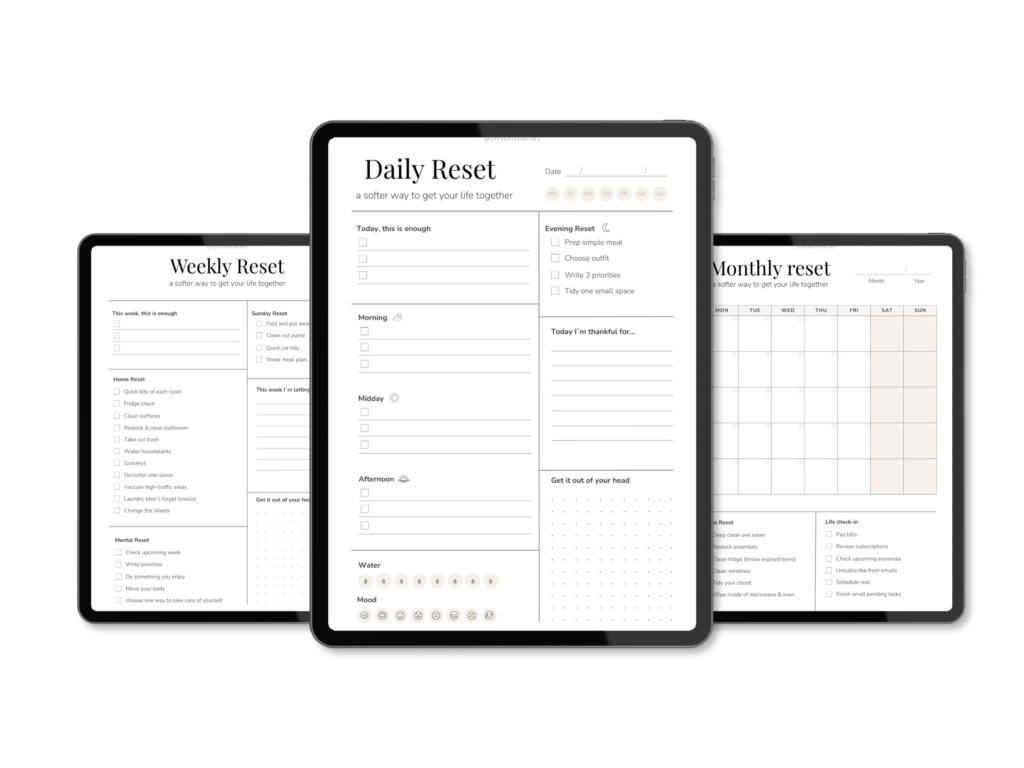
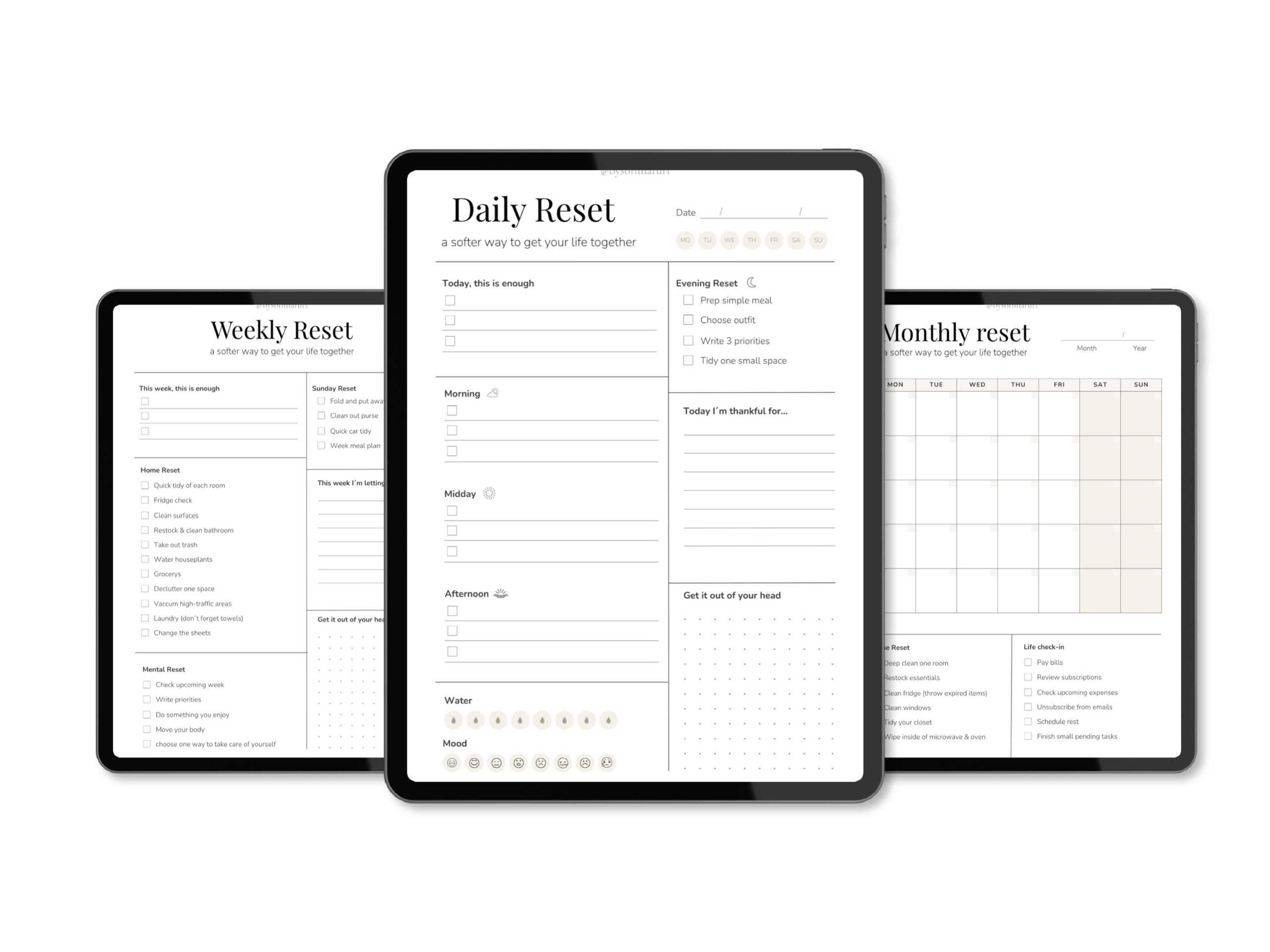
    Since I couldn’t find it, I decided to design my own system. I created a daily, weekly, and monthly reset planner pack designed specifically for scattered minds like mine, looking for a bit of order without losing their freedom. They are minimalist and functional templates that you can print or use digitally.

    They changed my life and helped me transform that chaotic month of unemployment into a period of great clarity and beautiful projects. If you feel like you are on that same roller coaster and need to ground your thoughts, [you can check them out here in my Etsy shop].

    Printable weekly planners to organize your week without a routine

    Final Tips: How to Organize Your Week Without Losing Your Mind

    If you are going through a job transition or simply feel like your head is going a thousand miles an hour, remember this:

    • Be kind to yourself: There will be days when you accomplish nothing you planned. It’s okay; tomorrow is a fresh start. On those tougher days, give yourself permission to step away — here are 20 screen-free things to do when you need to reconnect.
    • Choose the visual option: For scattered minds, out of sight, out of mind. Keep your planners where you can see them constantly.
    • Celebrate small wins: Did you manage to make that phone call you were putting off? Write it down and cross it off. The brain loves the dopamine of seeing completed tasks. Pour yourself a quiet ritual to celebrate the day — like this chamomile latte that replaced my evening coffee.

    Getting organized is not about becoming a robot; it is about creating the mental space necessary for your ideas to shine without causing you anxiety.

    Let’s navigate the chaos together.

    Transitioning to a new routine is hard, but you don’t have to do it alone. If you are ready to give your scattered mind a soft place to land, check out my printable and digital planners on Etsy. They were made by a scattered mind, for scattered minds.

    Printable weekly planners to organize your week without a routine

  • 20 Screen-Free Things To Do When You Need To Reconnect With Yourself

    20 Screen-Free Things To Do When You Need To Reconnect With Yourself

    11–17 minutes

    This post may contain affiliate links, which means I may earn a small commission if you choose to purchase through them — at no extra cost to you. I only share things I genuinely love or would use myself.


    If you’ve ever felt overstimulated, scattered, or just off, this list of screen-free things to do is for you. We talk so much, scroll so much, consume so much — and without realizing it, we stop hearing ourselves. Disconnecting isn’t about quitting technology. It’s about coming back to yourself: thinking, feeling, breathing, being present in your own life.

    So here are 20 simple, screen-free things to do when you need to reconnect with yourself — not to be more productive, but to feel more alive again.

    What does it actually mean to disconnect?

    Not fully disappearing.
    Not throwing your phone away.

    Just creating small moments where your brain isn’t constantly reacting to something.

    Moments where you’re not consuming, searching, or asking for answers.

    Just… thinking.

    People on their phones — why we need screen-free activities

    20 Screen-Free Things to Do When You Need to Slow Down

    1. Write by hand

    There’s something about writing slowly that makes thoughts feel more honest.

    Typing feels efficient.
    Writing feels real.

    I’ve been loving using a simple notebook like this — it makes the whole experience feel slower and more intentional.

    2. Read physical books

    No notifications.
    No tabs.
    No switching.

    Just you and a single train of thought.

    3. Keep a journal of questions, not answers

    You don’t need to solve your life. You just need better questions.

    If you don’t know where to start, something like a guided journal can actually help you think deeper.

    4. Draw or doodle what you are thinking

    Not everything has to be words. It doesn’t have to be perfect.
    You can even use the same notebook where you write your daily thoughts.

    5. Memorize something

    A sentence.
    A paragraph. Even a quote from your favourite movie or a new song that you´re enjoying.
    Something that stays with you. Right now for me is trying to learn this song from Olivia Dean.

    6. Copy by hand something you love

    There’s something powerful about slowing down enough to rewrite words that meant something to you.

    Try this:

    I am allowed to take my time.

    I am allowed to not have everything figured out.

    I am allowed to change my mind, to grow, to pause.

    Not everything needs to be productive to be meaningful.

    Not everything needs to be shared to be real.

    There is a version of me that exists without pressure, without noise, without comparison.

    I am learning how to come back to her.

    .

    7. Listen to music without doing anything else

    No scrolling.
    No multitasking.

    Just listening

    8. Eat without your phone nearby

    It sounds small, but it changes how present you feel. I’ve been trying to take one deep breath before I start eating.
    Just to slow down and actually be there.

    9. Take a shower without distractions

    This is where a lot of thoughts show up.

    Let them.

    I’ve been trying to make showers feel more intentional lately — using gentle scrubs, soaps with a nice scent, and actually slowing down.

    And at the end, a quick cold shower.
    It’s not the most comfortable thing, but it feels like a full reset.

    More Screen-Free Activities to Reconnect With Yourself

    10. Spend 10 minutes in the sun every day

    No agenda.
    No productivity.

    Just light.

    11. Walk without a destination or headphones

    It’s uncomfortable at first. But then your thoughts start catching up with you.

    12. Talk to people who think differently

    Not to convince them.

    Just to understand.

    13. Sit with a hard question for days

    Not everything needs to be figured out right now.

    Some questions are supposed to stay with you.

    If you don’t know where to start, try sitting with one of these:

    • What do I actually want, if no one was watching?
    • What am I avoiding by staying busy?
    • What would my life look like if I stopped trying to impress anyone?
    • When was the last time I felt truly like myself?
    • What am I afraid would happen if I slowed down?
    • What am I holding onto that is no longer me?
    • If I trusted myself more, what would I do differently today?
    • Don’t answer them.

    Just carry them with you.

    14. Stop rushing through everything

    This one is subtle.

    But it changes everything.

    Try noticing:

    • how you brush your teeth
    • how fast you drink your coffee
    • how quickly you move from one thing to the next
    • What happens if you just… slow that down?
    • Make yourself a slow, warm drink —🔗 like this chamomile latte that replaced my evening coffee — and actually sit with it.
    Eating breakfast without a phone — screen-free habit

    15. Be bored on purpose

    We avoid boredom like it’s a bad thing.

    But it’s actually where your mind starts creating again.

    16. Watch the sky for 30 minutes

    It sounds simple.

    It kind of is.

    But it also resets something.

    Cloudy sky — screen-free things to do to reconnect

    17. Make small decisions without asking anyone

    We ask for opinions constantly.

    Sometimes, you just need to choose.

    Small things like:

    • what to wear
    • what to eat
    • how to spend your afternoon

    It seems small. But it builds something bigger.

    18. Have conversations with strangers

    You never know what perspective you’re missing.

    19. Explain something complex to someone

    It forces you to actually understand it.

    20. Stop multitasking

    It doesn’t make you more productive.

    Just more scattered.

    Final thoughts

    You don’t need to disconnect completely.

    You just need small moments that belong only to you.

    Moments where your thoughts are not interrupted, optimized, or filtered.

    Just yours.